

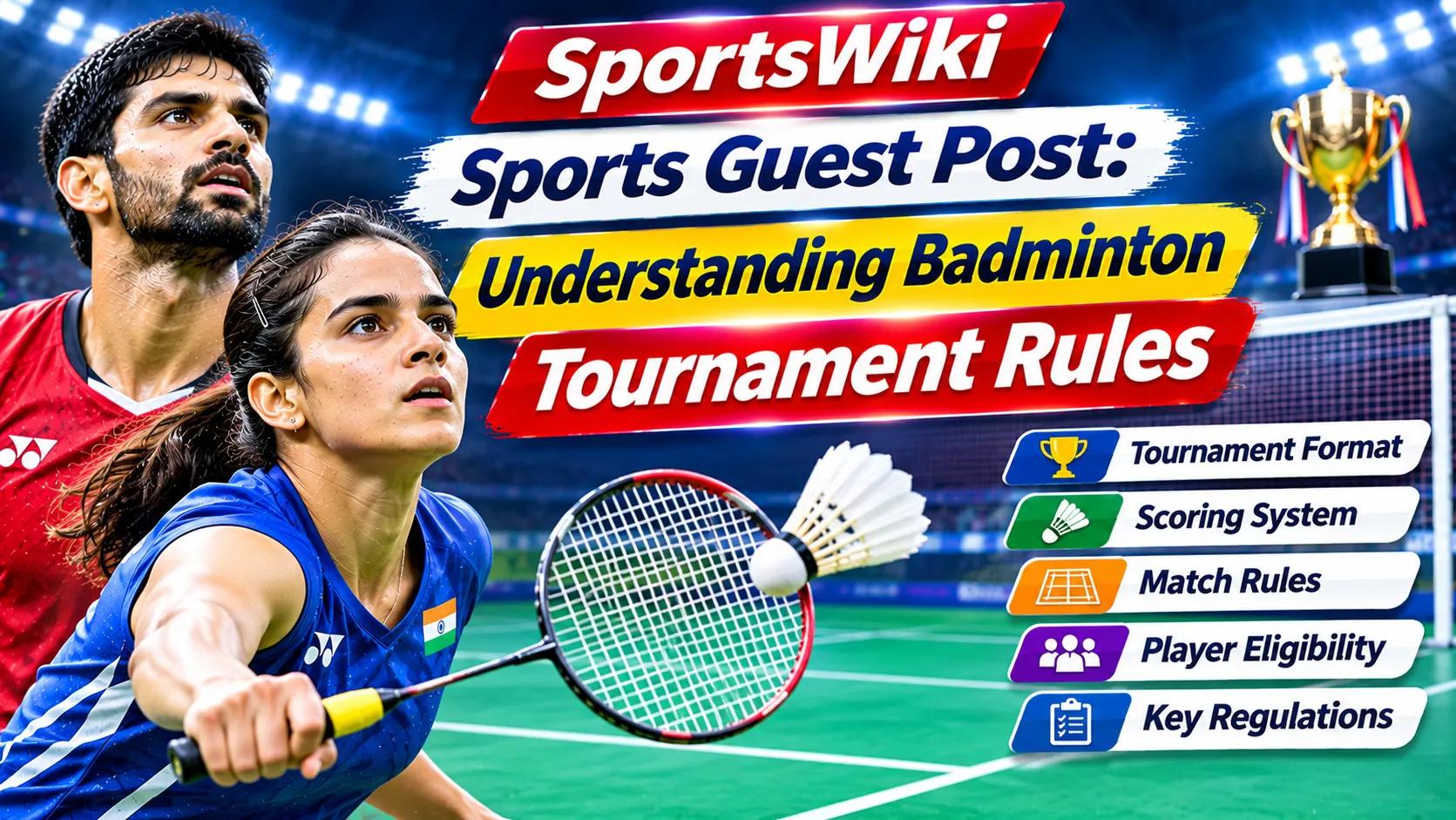
SportsWiki Sports Guest Post
SportsWiki Sports Guest Post: Understanding Badminton Tournament Rules
Badminton is one of the fastest and most exciting racket sports, combining speed, precision, agility and tactical thinking. From international championships to local competitions, the game attracts millions of players and spectators worldwide. However, enjoying a badminton match becomes even more interesting when you understand its scoring system, court regulations, serving techniques and tournament formats. For readers exploring SportsWiki sports blogs, learning the basic rules of badminton provides a useful introduction to one of the world's most popular indoor sports.
Professional badminton tournaments follow regulations established by the Badminton World Federation (BWF). These rules ensure fair competition and maintain consistency across international events. Whether you are a beginner learning the game or a regular follower of international badminton, understanding these regulations helps you appreciate the skills and decisions that influence match results.
Understanding the Basics of Badminton
Badminton is played between two opposing sides using rackets and a shuttlecock. It can be organised in five main competitive categories: men's singles, women's singles, men's doubles, women's doubles and mixed doubles.
In singles, one player competes against another, while doubles matches feature two players on each side. Mixed doubles teams consist of one male and one female player.
The objective is to hit the shuttlecock over the net and land it inside the opponent's court. Players must prevent the shuttlecock from touching the ground on their side while attempting to create difficult situations for their opponents.
A rally continues until the shuttlecock lands outside the court, touches the ground, fails to cross the net or an infringement occurs. The side that wins the rally receives a point.
Badminton Court Dimensions and Equipment Rules
A standard badminton court is rectangular and divided into two equal halves by a net. According to BWF regulations, the court measures 13.4 metres in length.
The court width differs depending on the competition format. Singles matches use a narrower playing area of 5.18 metres, while doubles matches use the full width of 6.1 metres.
Court markings identify the service courts, sidelines, baselines and other playing boundaries. These lines are important because the shuttlecock must land within the appropriate area to be considered valid.
The net is positioned at the centre of the court. Its height is approximately 1.55 metres at the posts and 1.524 metres at the centre.
Players use lightweight rackets designed for quick movements and controlled shots. The shuttlecock, commonly called a birdie, may be made using natural feathers or synthetic materials. Its design allows it to travel differently from traditional balls used in other racket sports.
How the Badminton Scoring System Works
Badminton follows a rally-point scoring system, meaning a point is awarded after every rally regardless of which side served.
A standard match is played as the best of three games. The first side to reach 21 points wins a game, provided it has at least a two-point advantage.
If the score reaches 20–20, the game continues until one side establishes a two-point lead. However, if the score reaches 29–29, the side that scores the 30th point wins the game.
For example, if a player reaches 21 points while the opponent has 18, the game ends because the winning player has achieved the required two-point difference.
The winner of the first two games wins the match. If both sides win one game each, a deciding third game determines the overall winner.
This scoring format keeps matches competitive because players cannot rely only on their serving opportunities to collect points.
Understanding Badminton Serving Rules
Serving is one of the most important parts of badminton. A legal serve must follow specific conditions established by the BWF.
The server and receiver must stand within their respective service courts without touching the boundary lines. The shuttlecock must be hit below the permitted service height, currently 1.15 metres from the court surface under BWF regulations.
The racket must initially hit the base of the shuttlecock, and the server must deliver the shuttle diagonally into the opponent's service court.
In singles, players serve from the right service court when their score is even and from the left when their score is odd.
In doubles, service rotation and positioning follow a different arrangement. The serving side changes its service court according to its score, and the receiving side must maintain the correct player positions.
An incorrect serve can result in a fault and award a point to the opposing side.
Important Badminton Faults and Violations
Badminton matches require players to follow several rules throughout a rally. Breaking these regulations results in a fault, which gives the opponent a point.
Common badminton faults include:
Hitting the shuttlecock outside the court boundaries.
Failing to send the shuttlecock over the net.
Touching the net with the racket, clothing or body during play.
Hitting the shuttlecock twice consecutively by the same player or side, except where permitted by the rules.
Allowing the shuttlecock to touch the ground on the player's side.
Deliberately distracting or obstructing an opponent.
Serving incorrectly or from the wrong service court.
Players must also avoid carrying or catching the shuttlecock on their rackets. These regulations help maintain the speed, fairness and competitive nature of the game.
How Badminton Tournaments Are Organised
Badminton tournaments use different competition formats depending on the number of participants and the nature of the event.
Knockout tournaments are among the most common formats. Players or teams compete in elimination rounds, and the winners progress to the next stage. Losing a match generally means elimination from the competition.
Some championships also use group-stage formats. Participants are divided into groups and play against other competitors within their assigned sections. The best-performing players advance to the knockout stages.
International badminton competitions include BWF World Tour events, continental championships, team competitions and the Olympic Games.
Major tournaments such as the All England Open, BWF World Championships and Thomas and Uber Cup attract leading players from different countries. These competitions provide opportunities for athletes to demonstrate their abilities and improve their international standing.
For sports enthusiasts who regularly follow international competitions, sports blogs can be useful sources of tournament explanations, player profiles, match discussions and badminton-related information. Reading informative articles also helps beginners understand how professional competitions operate.
Player Conduct and Umpire Responsibilities
Professional badminton requires discipline and respect for competition officials. Players must follow instructions, avoid deliberate delays and maintain appropriate behaviour throughout matches.
The umpire is responsible for controlling the match and ensuring that the competition follows the applicable regulations. Other officials may include service judges and line judges.
Line judges determine whether the shuttlecock lands inside or outside the court boundaries. Service judges monitor serving regulations and identify potential service faults.
Players can receive warnings or penalties for misconduct, including deliberate delays, inappropriate behaviour and repeated violations. Serious misconduct can lead to disqualification under the applicable tournament rules.
These responsibilities help maintain professional standards and ensure that matches are conducted fairly.
Why Understanding Badminton Rules Matters
Knowing badminton rules makes the game easier to follow and improves the overall viewing experience. Spectators can understand why a player receives a point, why a serve is considered invalid and how match situations develop.
For beginners, learning the regulations also helps prevent unnecessary mistakes during practice and competitions. Players can develop better serving techniques, improve court positioning and understand how to respond to different shots.
Sports writers can benefit from this knowledge as well. Accurate explanations of scoring systems, tournament formats and competition rules make sports articles more useful for readers.
Contributing original content to a relevant sports guest posting site can help writers share their knowledge with wider audiences. Guest publishing also creates opportunities to discuss different sporting disciplines, introduce emerging athletes and provide educational resources for sports enthusiasts.
Explore More Sports Content with SportsWiki
Badminton is just one of the many sports that bring together skill, determination and international competition. Cricket, football, tennis, athletics, hockey and basketball also have unique rules and tournament structures that deserve attention.
SportsWiki aims to provide readers with informative sports articles, educational guides and engaging discussions covering different games and competitions. Whether you want to understand badminton scoring, explore international cricket or follow major football tournaments, discovering reliable sports content can make your sporting experience more rewarding.
The digital publishing industry also offers specialised content opportunities through igaming guest posting, which focuses on online gaming, interactive entertainment and related industry developments. Publishers exploring this category should prioritise relevant platforms, original articles and responsible content practices.
Conclusion
Badminton tournament rules establish the foundation for fair and competitive matches. Understanding court dimensions, scoring methods, serving regulations, faults and tournament formats helps players and spectators appreciate the technical side of the sport.
From recreational games to international championships, these regulations ensure that badminton remains organised, exciting and competitive. Whether you are learning the game for the first time or following professional tournaments, knowing the rules makes every rally more meaningful.
Visit SportsWiki to explore more sports-related articles, discover useful competition guides and stay connected with the latest developments across the sporting world.
Check out most popular blogs
https://sportswiki.in/county-championship-2026-key-players-predictions/
https://sportswiki.in/javelin-throw-rules-and-measurement-explained/