

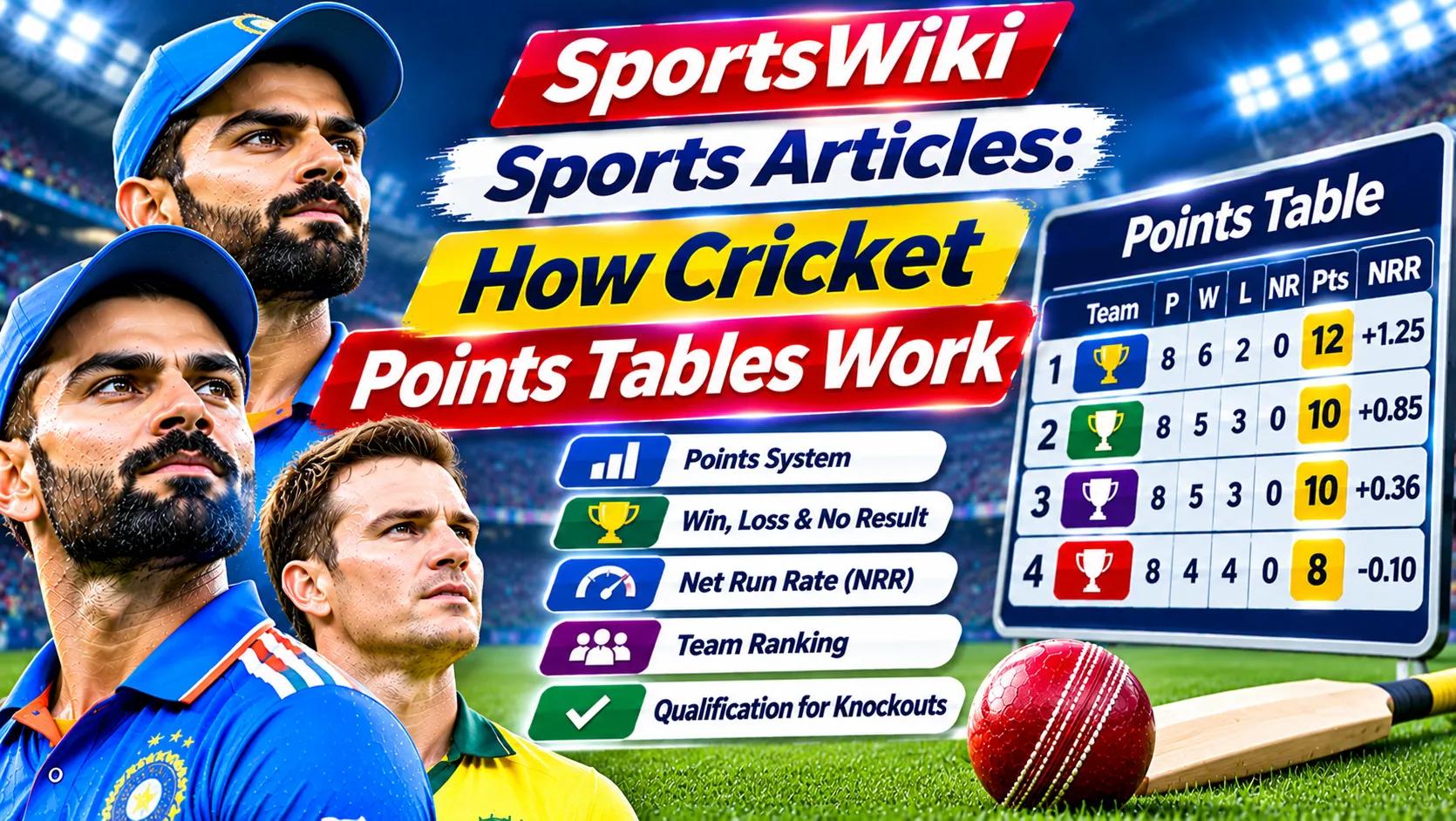
SportsWiki Sports Articles
SportsWiki Sports Articles: How Cricket Points Tables Work
Cricket tournaments become more exciting when every match has an impact on the competition standings. Whether it is an international series, a domestic league or a major franchise tournament, fans regularly check points tables to understand which teams are leading, which sides are struggling and who has the best chance of reaching the next stage. A cricket points table provides a clear picture of team performances throughout a competition. For readers who enjoy understanding match results, tournament formats and sporting statistics, SportsWiki offers an engaging platform to explore cricket coverage and informative sports blogs.
What Is a Cricket Points Table?
A cricket points table is a ranking system used to organise teams according to their performances in a tournament. It records important details such as matches played, wins, losses, ties, no-results, points earned and net run rate.
The main purpose of a points table is to identify the strongest teams during a competition. Instead of judging teams by individual match victories alone, the system considers their overall performance across the tournament.
For example, a team that wins five matches out of seven will generally have a stronger position than a team that wins only three. However, when teams finish with equal points, additional criteria such as net run rate or head-to-head results may determine their positions.
Points tables are particularly important in tournaments where teams compete in a league stage before qualifying for knockout rounds.
Understanding the Main Columns in a Cricket Points Table
Although the layout can differ between competitions, most cricket points tables contain similar information. Understanding these columns helps fans interpret tournament standings correctly.
Played (P): This indicates the total number of matches a team has completed. It helps readers understand how much of the tournament each team has played.
Won (W): This shows the number of matches won by a team. Wins usually contribute the highest number of points in a standard league format.
Lost (L): This records the number of defeats. A higher number of losses generally makes qualification more difficult.
Tied (T): This represents matches that finish with both teams scoring the same total under the applicable playing conditions. Points allocation depends on the tournament's rules.
No Result (NR): This column records matches that cannot produce an official result, often because of rain or other interruptions.
Points (Pts): This shows the total points earned by a team based on match results and the tournament's scoring system.
Net Run Rate (NRR): This is a statistical measure used to compare teams when they have equal points in many limited-overs competitions.
Together, these columns provide a useful summary of each team's tournament performance.
How Do Teams Earn Points in Cricket Tournaments?
Points allocation depends on the competition format and its official regulations. In many limited-overs league tournaments, a team receives two points for a win, one point for a tie or no-result, and zero points for a loss.
Consider a hypothetical tournament in which four teams have completed their matches:
Team A wins five matches and loses two, earning 10 points.
Team B wins four matches and loses three, earning 8 points.
Team C wins three matches, loses three and has one no-result, earning 7 points.
Team D wins two matches and loses five, earning 4 points.
In this example, Team A leads the table because it has collected the most points. Team B occupies second position, followed by Team C and Team D.
However, not every cricket competition uses exactly the same points system. Test leagues, domestic competitions and international tournaments may have different rules. Readers should always check the regulations of the specific event before interpreting its standings.
What Is Net Run Rate in Cricket?
Net run rate, commonly called NRR, is one of the most important statistics in limited-overs cricket. It is often used to separate teams that finish with the same number of points.
The calculation compares a team's average scoring rate with the average scoring rate of its opponents across the relevant matches.
The general formula is:
Net Run Rate = Average runs scored per over − Average runs conceded per over
For example, imagine a team scores 300 runs in 50 overs across its matches. Its average scoring rate is six runs per over. If its opponents score 250 runs in 50 overs, the average conceded rate is five runs per over. The team's NRR would be +1.00.
A positive NRR generally indicates that a team has scored faster than its opponents have scored against it. A negative NRR indicates the opposite.
The actual tournament calculation follows official playing conditions. All-out innings may be treated as having used the full quota of overs, even when a team loses its wickets earlier. This is one reason why NRR calculations can sometimes be more complicated than simply dividing runs by overs shown in a scorecard.
Why Net Run Rate Can Decide Qualification
Imagine two teams finish a league stage with 12 points each. If the tournament regulations use NRR as the first tiebreaker, the team with the higher net run rate may qualify ahead of the other.
This makes every run and every over important. A team can improve its NRR by winning convincingly, scoring quickly or restricting opponents to a lower total.
For example, chasing a target comfortably in fewer overs can improve a team's scoring rate. Similarly, dismissing the opposition early may reduce the average number of runs conceded per over.
However, teams should not focus only on NRR. Winning matches and collecting points remain the primary objectives. The exact tiebreaking order can also differ between tournaments.
How Cricket Points Tables Work in Different Formats
Points tables are not identical across every form of cricket.
T20 Leagues
T20 competitions generally feature a league stage in which teams play a fixed number of matches. Points are awarded for results, and the leading sides progress to the playoffs or knockout rounds.
The Indian Premier League is a familiar example of a T20 league where points and net run rate play an important role in determining standings and playoff qualification.
One Day International Tournaments
ODI tournaments may use a round-robin league format, groups or a combination of group stages and knockout matches. Teams collect points during the league stage, and qualification depends on their final positions and tournament regulations.
The ICC Cricket World Cup has used league-based standings in its recent editions, making points and NRR important for determining which teams progress.
Test Cricket Championships
Test competitions can use a different points structure. In the ICC World Test Championship, teams earn points according to the results of individual series matches, with draws and ties receiving different treatment from wins and losses.
Because series can contain different numbers of matches, the championship uses a percentage of points available to compare teams rather than relying only on total points. This makes the system different from the standard points tables used in many T20 and ODI leagues.
Why Points Tables Matter to Cricket Fans and Analysts
Points tables help fans follow the progress of a tournament without checking every individual scorecard. They reveal which teams are consistent, which sides need important victories and how close the competition is becoming.
Analysts also use standings to examine team performance. A team with several wins may appear strong, but its NRR can reveal whether those victories were convincing or narrowly achieved.
Sports writers can use these statistics to create match previews, tournament reviews, qualification scenarios and detailed cricket explanations. Readers looking for reliable sports coverage often explore a sports guest posting site to discover articles that explain tournament rules and sporting developments in an accessible way.
For publishers, topics such as points-table calculations, playoff qualification and tournament formats offer opportunities to create useful cricket content that remains relevant beyond a single match.
SportsWiki: Explore More Cricket Knowledge and Sports Articles
Following cricket becomes more enjoyable when fans understand the rules and statistics behind every competition. From points tables and net run rates to player rankings and tournament formats, detailed explanations help readers appreciate the strategy involved in professional cricket.
SportsWiki aims to bring sports enthusiasts informative articles covering cricket and other popular sporting disciplines. Readers can explore different subjects, learn about major competitions and discover stories that go beyond basic match results.
Contributors can also develop original articles about cricket statistics, international tournaments, legendary players and emerging sporting trends. The wider publishing landscape includes specialist areas such as igaming guest posting, alongside traditional sports coverage. Publishers and writers should choose relevant topics and maintain accuracy, originality and responsible editorial standards.
Conclusion
Cricket points tables provide a simple but effective way to measure team performance during a tournament. By understanding matches played, wins, losses, points and net run rate, fans can follow standings and identify which teams are moving closer to qualification.
Different competitions may follow different scoring systems, so checking official tournament rules is always important. Whether following a T20 league, an ODI championship or the World Test Championship, understanding the points table makes every result more meaningful.
Through informative SportsWiki articles and engaging sports blogs, cricket enthusiasts can continue learning about the statistics, rules and strategies that shape the game. Exploring quality sports content also helps readers discover new perspectives on their favourite competitions and stay connected with the wider sporting world.
Check out most popular blogs
https://sportswiki.in/indian-badminton-academy-inside-the-champion-pipeline/
https://sportswiki.in/saina-nehwal-olympic-medal-indias-badminton-awakening/